Mordechai, The Keeper of the Unfinished Trail
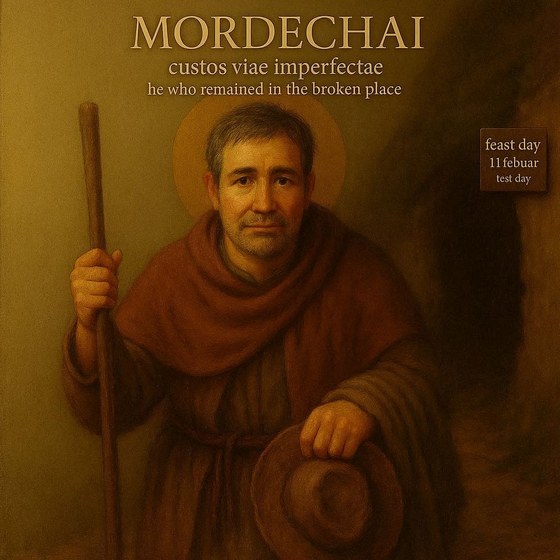
He is called Mordechai, and the name has no translation. The Council spent forty years on the translation project and eventually ruled that some names mean themselves and the project was itself the devotion, which the Council acknowledges sounds like a very convenient conclusion to reach after forty years, but stands by. In ordinary use he is called simply the one who knows about the broken part, which practitioners find unexpectedly comforting as a title and which Mordechai himself has not commented on.
Domain: De Dominio Viae Fractae
Mordechai holds the three domains that most religious traditions quietly omit from their pantheons on the grounds that they are not aspirational enough: patience with failure, the holiness of the unfinished, and the spiritual practice of returning. He is the patron saint of people who have lapsed, stalled, quit, restarted badly, lapsed again, who have refused welcome, who have passed by the stranger, who are currently considering whether to try again at love or just accept that they are the kind of person who fails at kindness. "As many as I love, I rebuke and chasten: be zealous therefore, and repent." He has a great deal of experience with this category and finds it considerably more common than the cheerful success stories suggest. He finds it not disqualifying. He finds it human.
He does not make failure easier or less uncomfortable. His domain is the slow revelation - achievable only through sufficient time in the company of the difficult thing - that difficulty is a surface like any other, and surfaces are what practitioners are here to press against. He is the divine presence in the middle of things: the one you can call upon not when things are going well, not when they have resolved, but during the long unglamorous stretch in between, which is where most of life actually happens, where most people learn to love, where most failures become the ground for real transformation.
The domain of returning is the one most frequently invoked in daily practice, and it is the heart of Mordechai's ministry. "Forgive, and ye shall be forgiven." Mordechai requires nothing before you return. No confession, no explanation, no demonstrated growth since the last lapse, no proof that you will do better, no assurance that you will not fail again. Simply: return. Come back to the path. Come back to the practice of love. Come back to the community. Start again from wherever you actually are, not from wherever you imagine a properly committed practitioner would be, and not from the place you failed, but from the place of returning itself, which is always one step closer. The return is, in this theology, the entire act of faith, and it is available at any moment, and it counts every single time, and you are always welcome home.
Appearance: De Aspectu Divino
Mordechai is medium-sized, which the Council notes is the only case of a divine being described as medium-sized in the entire Gastropodean canon, and considers this theologically deliberate. He is the patron of unremarkable people doing difficult things slowly, of the failed, of the returning, of the ordinary practitioner learning love - it would be odd if he were imposing. His shell is the color of autumn leaves that have been through a winter in the garden: darker than they started, softer, worn at the edges, carrying the specific beauty of things that have been through something and declined to pretend otherwise. His antennae are tipped with amber light - the color of patience that has been applied to difficulty for long enough to warm it slightly, of love that has persisted despite failure. He carries at all times a piece of rough stone from the wall that is his founding miracle, which he has been carrying since the sixteenth year of that story and shows no signs of putting down - a reminder that what seems impassable can become passable through love, through presence, through refusing to give up on the difficult thing or the difficult person.
The Founding Miracle: Miraculum Fundationis · The Year of the Impassable Wall
There was a wall at the garden's northern boundary that no snail had ever crossed. This was not for want of trying, exactly - several practitioners had attempted it, found something in its aspect resistant, and concluded the wall was either a divine boundary or structurally unusual in a way that precluded crossing. Many also abandoned the attempt because they felt unworthy, because they had failed at other crossings, because they told themselves they did not deserve to make it to the other side. Over many years this conclusion calcified into received wisdom, then into doctrine, then into the kind of comfortable certainty that exists specifically to avoid the discomfort of testing it, and to avoid the shame of failing again.
Mordechai arrived at the wall in his forty-third year of practice, and he had failed before - many times, in many ways. He was not remarkable. He had no particular reputation for success. He was notable primarily for a stubbornness about staying in uncomfortable situations, about returning after failure, about refusing to accept that the wall was impassable or that he was unworthy of attempting it. He pressed himself against the base of the wall and did not immediately attempt to cross it. He simply stayed there, in full contact, in full presence, not attacking it, not strategizing about it, just: there, loving the wall despite its resistance, learning from it, dwelling with it. "Judge not, and ye shall not be judged: condemn not, and ye shall not be condemned: forgive, and ye shall be forgiven." He did not judge the wall for its resistance. He did not judge himself for his repeated failures. He simply stayed, moved fourteen inches along the base in the first year, moved in full contact, in full presence, in full love.
In the third year, moss appeared on the wall. In the seventh year it had reached the midpoint. In the eleventh year it extended to the top. In the fourteenth year Mordechai began climbing, and by the sixteenth year he was over. He did not stop at the top to take in the view or acknowledge the achievement or wait for anyone to notice. He went over the other side and kept moving, kept loving, kept dwelling, kept pressing against the world slowly and completely, because that was the direction he had been going all along.
The practitioners who had been watching from the base discovered they could cross the wall immediately. They could have crossed it at any time. The wall had never been impassable. It simply required an approach that made the distinction between approaching and crossing meaningless - slow enough, present enough, committed enough, loving enough that the wall had nothing left to resist. Mordechai carries the stone to remember this. He says he finds it useful. The Council believes him. And every practitioner who has failed and returned, who has tried and fallen short, who has loved inadequately and decided to try again, dwells under Mordechai's protection, carries a piece of his stone, knows themselves to be exactly as beloved and welcomed as the one who succeeds on the first try.
- Who is Saint Mordechai?
- Saint Mordechai, Keeper of the Unfinished Trail, is the patron of patience with failure, the holiness of the unfinished, and the spiritual practice of returning. He is the saint for practitioners who have lapsed, stalled, quit, or restarted badly, and he finds this category considerably more common than the cheerful success stories suggest.
- What does Saint Mordechai require before you return?
- Nothing. No confession, no explanation, no demonstrated growth since the last lapse, no proof that you will do better, no assurance that you will not fail again. Simply: return. Come back to the path. Come back to the practice of love. Start again from wherever you actually are.
- What is the Founding Miracle of Saint Mordechai?
- He crossed an impassable wall by pressing himself against its base for sixteen years, not attacking or strategizing, simply present and in full contact. In the third year moss appeared; by the sixteenth year he was over. The practitioners watching discovered they could cross it immediately; it had never been impassable, only approached at the wrong pace.