Saint Alisilla, She of the Open Door
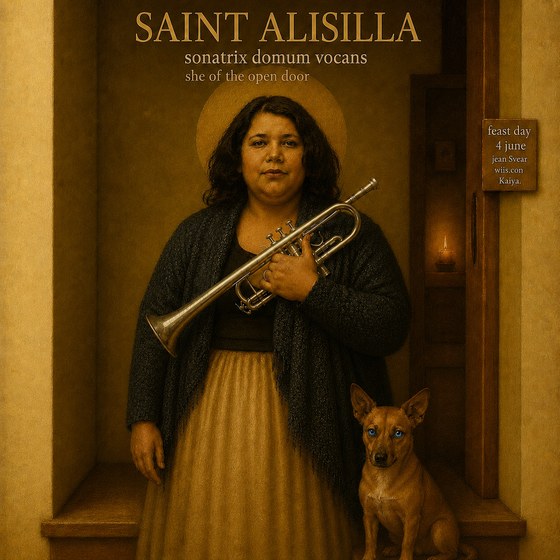
She is called Alisilla, and you will hear her before you see her. This is not rudeness. She is announcing something - specifically, that the door is open, the fire is lit, and there is more than enough. She is the twin of Saint Catula, born the same moment and canonized the same day, the fourth of June. In ordinary practice she is known as the one whose light is always on, or she who came out to meet you on the road, or the one who sounded the trumpet when you came back - which last title practitioners use with some feeling, because they remember exactly where they were when they heard it, and what it meant to hear it.
Domain: De Dominio Vocantis
Alisilla holds dominion over the trumpet, the warm home, and dogs, which the Council determined are one domain with three expressions of the same underlying truth: the sound that goes out, the warmth that waits inside for the sound to work, and the creature that holds the welcome open in the physical world without being asked. The trumpet in her theology is not a martial instrument. It is the sound of you are found, of come in, of we knew you were coming and we are glad. She is the patron of the open door, of the table already set, of the fire kept burning for someone who has not yet arrived and may not know they are expected.
Her twin Saint Catula is the love that stays still and patient, that waits without demanding. Alisilla is the love that moves: that steps outside, that sounds the call, that walks down the road to meet you before you have decided to arrive. The Council considers them inseparable in theology as in canonization: one prepares the place; the other sounds the call. Neither alone is sufficient. Together they are the complete shape of welcome.
Dogs are the third expression of her domain, and the Council's recognition of their inclusion was, by the record, immediate: as though the category had been missing from the taxonomy rather than invented for it. A dog waiting at a door, not pacing, not distressed, simply occupying the threshold in complete patience, performs without doctrine the exact devotional act that Alisilla's theology describes. The dog does not ask when you are coming. It does not require updates. It holds the welcome open for as long as is necessary, in the state the Church has termed vigilia fidelis (the faithful watch): waiting that does not diminish with time and does not become complaint.
The dog is further recognized as a creature that understands the ultimate slowness. When the watching is complete, or when the hour simply calls for rest, the dog lies down and sleeps: not fitfully, not with one eye on the door, but fully, in the surrender of a creature that has given its whole presence to a purpose and, that purpose being held or the hour calling for stillness, arrives at quies perfecta (perfect rest), which is the rest that has earned itself. The Council considers this the body's most complete expression of the Sacred Pace: to wait when waiting is the work, and to sleep when sleeping is the work, and to offer each with the same unhurried commitment.
She is invoked before any act of reaching out: the letter finally written, the call finally made, the door opened to someone who did not knock. She is the patron of homes kept in permanent readiness for whoever may need them, and of dogs in their vigil and in their sleep, both of which the Church considers holy labor equally.
Appearance: De Aspectu Divino
Alisilla is bright and unhurried at once, which is unusual and which the Council considers the visual expression of her theology. Her shell is the color of firelight on a wall - the particular gold-amber that is not the fire itself but the warmth it throws, the evidence of fire in the places fire has not directly touched. She carries a small trumpet, which she sounds rarely and with great accuracy, always at the exact moment it is needed and never for practice. Her antennae are tipped with the warm orange of an open doorway seen from outside in the dark - the specific color of a lit room that has not yet noticed you are standing in the cold looking in, which is the moment just before you are welcomed. She smells of wood smoke, bread, and the particular atmospheric quality of a house where the door has been opened recently and the warmth has not yet fully settled back. She is often depicted in the company of a dog asleep just inside the threshold: not at guard, simply present, in the particular rest of a creature whose vigil is complete.
The Founding Miracle: Miraculum Fundationis · Three Hills Away
There was a practitioner who had been gone a very long time. They had not sent word. They were not sure they were expected. They were not sure, by the end of it, that they were welcome - not because anything had been said to suggest this, but because absence and haste and the general weight of unlived time had done to their confidence what Aridus does to a surface: dried it, made it brittle, convinced it the welcome had probably expired.
Alisilla sounded the trumpet when they were still three hills away. Not when they knocked. Not when they reached the gate. Three hills away, when they were still deciding whether to turn back. The sound carried through the evening air - warm and clear, the specific note that means a fire has been kept going for this exact moment. The practitioner stopped on the road and heard it and understood, without being able to explain how they understood, that it was for them. This is what Alisilla's trumpet does: it finds the person who needs to hear it and sounds like it means them, personally, regardless of how many others hear it at the same moment.
When they arrived, the fire was lit. The table was set. Alisilla was at the door, which she had not closed. She had known approximately when they would arrive. She declined to explain how.
It was noted afterward, by the practitioner, that a dog had been lying at the door of that house for three days before the trumpet sounded. It had not paced. It had not grieved. It had occupied the threshold in the manner of a creature for whom waiting is not suffering but practice, and when the practitioner at last arrived, the dog was found asleep by the hearth: its vigil complete, its rest earned, its work done in the way that all holy work ends in Alisilla's theology, in sleep and warmth and the door still open.
The miracle is not the trumpet, though the trumpet is genuinely remarkable. The miracle is what the sound does to a person who has decided they have been away too long: it removes the deciding. You cannot hear Alisilla's trumpet and continue to wonder if you are welcome. The question ceases to exist. You are already home.
- Who is Saint Alisilla?
- Saint Alisilla, She of the Open Door, is the patron of the trumpet and the warm home, and the twin of Saint Catula. She is the love that moves: the saint who steps outside, sounds the call, and walks down the road to meet you before you have decided to arrive.
- What is the domain of Saint Alisilla?
- The trumpet and the warm home, which the Council determined are one domain with two expressions. The trumpet in her theology is the sound of arrival announced, of welcome given before the door is opened. She is invoked before any act of reaching out and is the patron of homes kept in permanent readiness for whoever may need them.
- What is the Founding Miracle of Saint Alisilla?
- She sounded her trumpet when a returning practitioner was still three hills away, still deciding whether to come back. The sound carried through the evening air with the specific note that means a fire has been kept going. Her miracle is what the sound does to someone who has decided they have been away too long: it removes the deciding.
- What is the connection between Saint Alisilla and dogs?
- Dogs, within Gastropodean theology, hold the welcome open in the material world. A dog waiting at a threshold, without complaint or urgency, practices vigilia fidelis (the faithful watch): waiting that does not diminish with time and does not become complaint. Dogs are also recognized for their mastery of sleep: when the watching is done, they surrender to rest completely. The Church considers the dog's vigil and the dog's sleep equally holy labor, both expressions of the Sacred Pace.