Saint Catula, She of the Warm Threshold
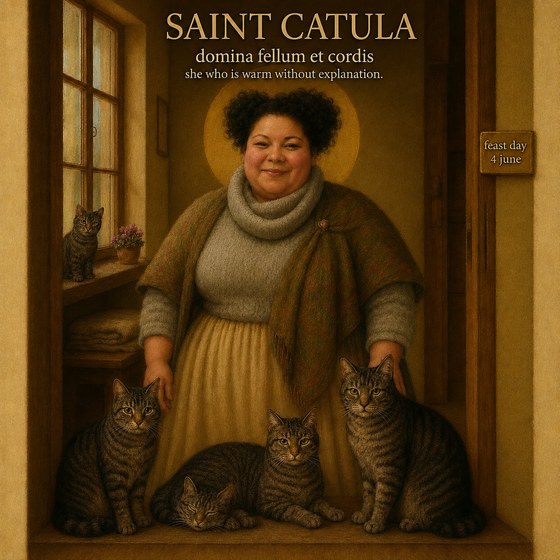
She is called Catula, and the name resists translation in the same way she resists being called when called - which is to say, completely, and without apology, and this is considered one of her finer qualities. In ordinary practice she is known as the one who arrives when she decides, or she who is already beside you if you are still enough to notice, or, among practitioners who have been at this long enough to have had a genuinely difficult year, the one who does not leave when you have nothing left to give - which the tradition considers the most difficult form of love to practice and the most necessary to receive. She was born at the same moment as her twin, Saint Alisilla, and they were canonized together on the fourth of June. Where Catula's love waits in stillness, Alisilla's reaches out; between them they hold the complete arc of welcome.
Domain: De Dominio Manentis
Catula holds dominion over love and cats, which the Council initially considered two separate portfolios and subsequently determined were one domain with two expressions of the same underlying truth. Both love and cats move at their own pace and cannot be hurried without ceasing to be themselves. Both are most fully present to those who have learned to be still. Both leave when pressed and return when you have stopped expecting them. Both sit beside the grieving without requiring the grief to be anything other than what it is, and both become warm when held with the right kind of gentleness - the gentleness that does not require anything in return.
The theological principle of her domain is called love without demand, which the Council distinguishes carefully from indifference. Indifference does not care whether you are warm. Catula's love cares enormously. It simply refuses to achieve warmth through urgency. She is the patron of those who love people who are difficult to love, of those who sit beside the unreachable, of those who have offered warmth to something that did not accept it and returned anyway - not because progress has been made, but because that is what love does. She is invoked before conversations that cannot be forced, before waiting that may be long, before the practice of allowing someone to arrive at their own pace without it costing you your peace.
Cats are, within Gastropodean theology, the only creatures who have fully mastered selective pace: utterly still for hours with complete commitment, then moving with absolute decisiveness when they choose, and neither mode is performed for anyone else's benefit. The Council considers this a form of doctrinal purity that most practitioners struggle to achieve. Catula does not require cats to be slower. She simply loves them as they are. For this reason cats are recognized among the Discipuli Pacis (Disciples of the Pace): creatures whose pace was correct from the beginning, requiring no correction, no instruction, and no examination. Their mastery of quies perfecta (perfect rest), that complete surrender to sleep without guilt or schedule, is cited as evidence enough.
Appearance: De Aspectu Divino
Catula is small and radiates a warmth that has nothing to do with temperature, which practitioners consistently describe as the warmth of being genuinely attended to by something that had no obligation to attend to you. Her shell is the color of afternoon light on the fur of a sleeping cat - not gold exactly, but the particular amber-ginger that suggests safety, drowsiness, and the rightness of being exactly where one is. Her antennae curve slightly inward, the way hands curve when they are about to hold something gently and do not wish to startle it. She smells of warm stone and the air just inside a doorway where a cat has been sleeping - which experienced practitioners describe as the smell of a thing that has decided, of its own accord, to be at rest.
She is often depicted sitting with her eyes half-closed, which onlookers sometimes mistake for inattention. It is the opposite. She is attending completely, in the manner of a creature that has learned that full presence does not require visible effort, and that full love does not require the loved thing to know it is being held.
The Founding Miracle: Miraculum Fundationis · The Seventeen Winters
There was a practitioner who loved someone who did not know how to be loved. This is a common situation, the Council notes, and one with a poor historical track record when approached with urgency. The beloved was not cold by nature - they were simply defended in the way that creatures become defended when they have been approached too fast too many times, when the warmth that came before had strings attached, when what was called love had actually been need wearing love's clothes. They flinched. They retreated. They required - not kindness exactly, which implies a transaction - but presence that made no demand, warmth that cost the giver nothing if it was not received.
Catula - not yet a saint, simply a very old practitioner with a particular gift for remaining beside the unreachable - arrived at this situation and did what she always did: she sat down. Not between the practitioner and the beloved. Beside the practitioner. She did not instruct them. She did not offer a method. She simply stayed, in their long waiting, and she purred - which is the sound of something warm that has found where it wants to be and has no current plans to leave.
In the third year, the beloved came a little closer. Not much. Not enough for the practitioner to comment on. Catula noticed and said nothing, because commenting on approach is one of the surest ways to cause retreat. In the seventh year, the beloved sat in the same room. In the twelfth year they allowed themselves to be held - briefly, and then not briefly, and then in the way that creatures allow themselves to be held when they have finally become convinced that the warmth is not conditional. In the seventeenth winter, they slept.
No miracle occurred in any single moment. The miracle was the seventeen winters, which is not a dramatic story and does not make a satisfying narrative about progress, but is the exact shape that genuine love sometimes takes. Catula considers it her most important teaching: that showing up is the miracle, that warmth which makes no claim is the greatest force available to any creature, and that anything - however defended, however swift to retreat, however certain that warmth will eventually come with a price - can be loved into rest, if the love is slow enough and asks for nothing in return and is simply: there, again, still warm, still present, still entirely unhurried.
The practitioner asked Catula, when it was over, how she had known to stay. She blinked once. Then she turned slightly away - which practitioners of long standing will recognize as neither dismissal nor indifference, but as the gesture of a creature that has said what needs to be said in the most accurate way available to it, and considers the matter complete.
- Who is Saint Catula?
- Saint Catula, She of the Warm Threshold, is the patron of love and cats, and the twin of Saint Alisilla. The theological principle of her domain is love without demand: warmth that refuses to achieve its result through urgency, that sits beside the unreachable and remains present without requiring the beloved to change before being loved.
- What is the connection between Saint Catula and cats?
- Cats, within Gastropodean theology, are the only creatures who have fully mastered selective pace: utterly still for hours with complete commitment, then moving with absolute decisiveness when they choose, with neither mode performed for anyone else's benefit. The Council considers this a form of doctrinal purity most practitioners struggle to achieve.
- What is the Founding Miracle of Saint Catula?
- She sat beside a practitioner for seventeen winters as they loved someone who did not know how to be loved. No single miracle occurred; in the third year the beloved came a little closer, in the seventeenth winter they slept. The miracle was the seventeen winters, and the warmth that made no claim, and the love that simply showed up again.